

Choosing the best data storage systems is essential for cost-effectiveness, scalability, and performance in today’s digital-first business environment. Your storage architecture supports everything from standard file sharing to mission-critical applications, regardless of how big or small your business is.
Each of the three top options—Cloud Storage, Network Attached Storage (NAS), and Storage Area Network (SAN)—offers unique benefits and compromises.
This guide will explain each choice, point out important factors, and demonstrate how working with Bluechip Gulf can make the process of finding the perfect storage solution easier.
Understanding the Options – Cloud, NAS, and SAN
- Cloud Storage
Cloud-based storage makes use of distant servers that are housed by companies such as Google Cloud, AWS, or Azure. Cloud storage eliminates the need for onsite maintenance and upfront hardware investments, making it the perfect choice for companies that require quick scalability. Its global distribution guarantees high availability and disaster recovery, and its pay-as-you-go model matches expenses with actual usage.
- Network Attached Storage (NAS)
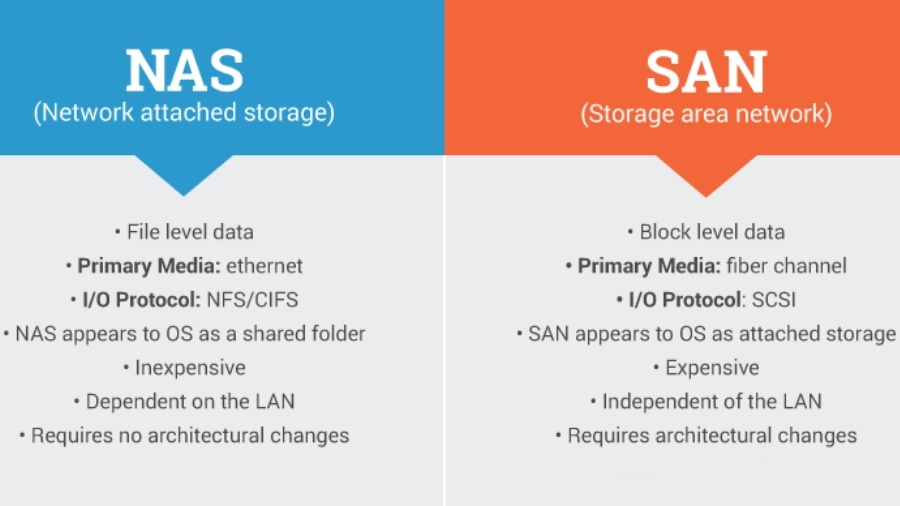
NAS devices are standalone appliances that are linked to your local network and provide centralized file sharing via SMB/CIFS and NFS protocols. They are excellent at offering simple setup, departmental or workgroup-level access, and integrated redundancy through RAID configurations. NAS is an affordable option for media streaming, backups, and group file storage.
- Storage Area Network (SAN)
Multiple servers can access shared storage as if it were a local disk thanks to SANs, which provide block-level storage over a dedicated high-speed network (typically Fibre Channel or iSCSI). Large-scale transactional applications, virtualization clusters, and high-performance databases are all supported by this architecture. SANs provide fine-grained storage allocation, advanced replication, and low latency.
Key Criteria for Choosing the Right Storage
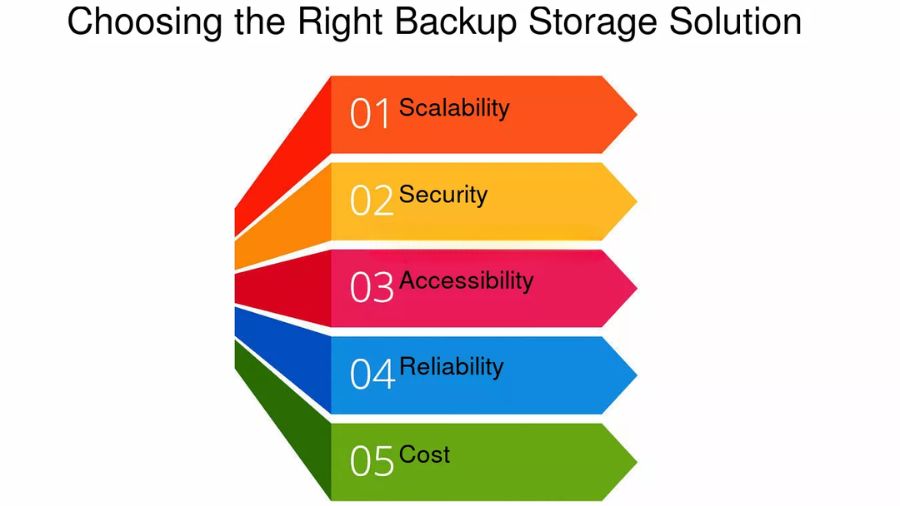
- Performance Requirements
- Cloud – Your internet connection and the region of your provider determine latency and bandwidth. Perfect for workloads requiring a moderate amount of input/output.
- NAS – Good for backup and file-sharing tasks; Ethernet speed (1–10 GbE) may limit performance.
- SAN – Designed to support demanding applications like VMware, SQL Server, and Oracle, it has low latency and high IOPS.
Scalability and Flexibility
- Cloud – On-demand provisioning and nearly infinite capacity. Storage can be scaled up or down with just a few minutes notice.
- NAS – Depending on the chassis and performance, there are practical limitations. Scale by adding disks or clustering NAS appliances.
- SAN – Excellent for large-scale deployments, but requires careful capacity planning due to its modular expansion via additional arrays or controllers.
Management Complexity
- Cloud – Provides cloud-specific administration (IAM, billing, data egress controls) while offloading hardware management.
- NAS – Easy-to-use web-based connections and user management; perfect for IT teams with little experience with storage.
- SAN – Best managed by seasoned storage administrators; requires a specific understanding of storage fabrics, zoning, and multipathing.
Cost Considerations
- Cloud – OPEX model; monthly fees are predictable, but egress charges could be erratic.
- NAS – CAPEX hardware investment; lowers ongoing costs but requires power/cooling and periodic refresh cycles.
- SAN – Long-term value in high-utilization, mission-critical scenarios; higher initial CAPEX for controllers, switches, and arrays.
Ensuring Resilience with Data Protection Systems

Integrating strong data protection systems is a must regardless of the platform you choose. Think about –
- Clones and snapshots – Quickly take point-in-time pictures for easy rollback. Extensively supported by numerous NAS models and SAN arrays.
- Replication – Either synchronous or asynchronous replication to a cloud or backup location. Essential for disaster recovery and high availability.


- Backup and Archival – Use a 3-2-1 approach for backup and archiving: make three copies of your data on two separate media and one off-site. While SAN ecosystems might need specialized backup solutions, cloud, and NAS appliances frequently come with built-in backup software.
- Encryption – Both in-transit and at-rest encryption prevent unwanted access or eavesdropping, which is especially crucial for cloud deployments.
You can protect business continuity and fulfill compliance requirements by combining your selected storage infrastructure with all-inclusive data protection systems.
Use Cases and Best Practices

- When to Choose Cloud Storage
- Startups that are expanding quickly and have erratic capacity requirements.
- Teams working remotely need to have worldwide access to shared files.
- Projects that need to be stored temporarily or seasonally (like media rendering).
- Businesses looking for disaster recovery as a service (DRaaS) without the need for a backup data center.
Best Practice – To reduce monthly expenses, use lifecycle policies to automatically tier older data to less expensive storage classes.
When to Choose NAS
- Centralized file servers are necessary for small and medium-sized enterprises.
- Departments that deal with a lot of unstructured data (engineering files, graphics, and videos).
- Environments that place a high value on affordability, speed of deployment, and simplicity.
Best Practice – For high resilience and reliable performance, use dual-controller NAS clusters with RAID-6 or RAID-10.
When to Choose SAN
- Businesses that use virtualization farms, ERP systems, or high-performance databases.
- Data centers need low-latency access and guaranteed input/output.
- Companies that require multi-site replication and strict SLAs.
Best Practice – To reduce single points of failure, incorporate unnecessary switches and multipath I/O (MPIO) into your SAN fabric design.
Hybrid and Multi‑Cloud Strategies
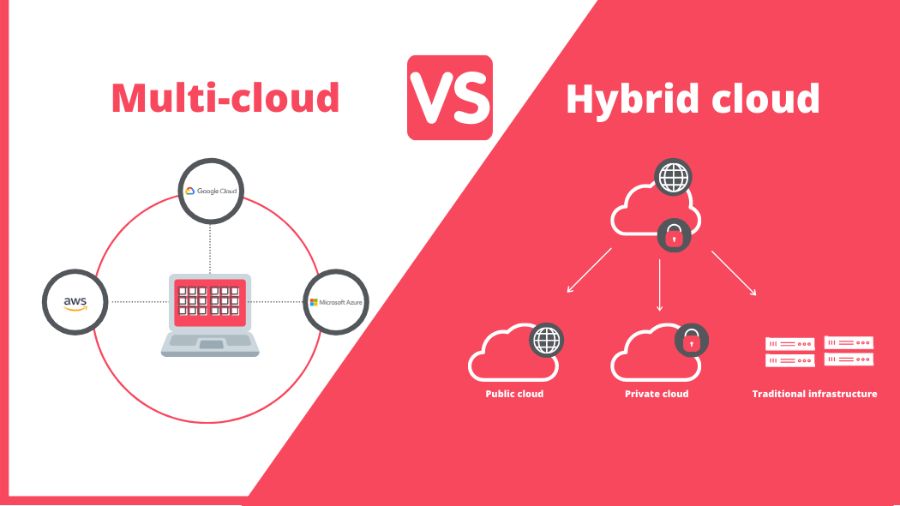
In an effort to balance performance, cost, and flexibility, companies are increasingly integrating Cloud, NAS, and SAN into hybrid architectures –
- Tiered Storage Architectures – Store cold archives in the cloud, warm data on NAS, and hot data on SAN for quickest access.
- Cloud Burst for SAN – During periods of high demand, shift excess workloads to cloud block storage.
- NAS-to-Cloud Sync – For offsite backup and remote collaboration, automatically mirror file shares from NAS to cloud storage.
These hybrid strategies maintain the advantages of each storage tier while optimizing resource usage and cost-effectiveness.
Partnering with Bluechip Gulf for Optimal Storage Solutions
It takes seasoned experience to navigate the intricacies of data storage systems and protection systems. From requirements analysis and architecture design to execution and continuing management, Bluechip Gulf provides comprehensive services. Among their remedies are –
- Consultation & Assessment – Determine the best combination of Cloud, NAS, and SAN by examining your workloads, performance requirements, and financial constraints.
- Design and Deployment – Set up cloud environments, SAN fabrics, or high-availability NAS clusters with best-practice backup and security measures.
- Managed Services – Organize backups and replication, optimize capacity utilization, and keep an eye on storage health to guarantee smooth operation.
- Training & Support – Provide your IT staff with instruction on recovery protocols, tiering policies, and storage management.
Working with Bluechip Gulf gives you access to a reliable advisor who will secure your data landscape for many years to come by coordinating state-of-the-art technology with your strategic goals.
Conclusion
Budgetary restrictions, management skills, scalability needs, and performance demands all play a role in selecting the best storage paradigm: cloud, NAS, or SAN. No one solution works in every situation. However, you can create a robust architecture that changes with your business by comparing each option to the workload profiles of your organization and incorporating strong data protection systems.
Bluechip Gulf is the leading supplier of enterprise-grade storage solutions in the area; contact them for customized advice and turnkey implementation. Provide your company with the appropriate data storage solutions now to set the stage for a future that is high-performance, scalable, and safe.


